

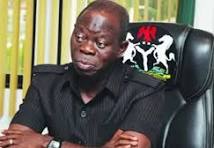
Senator Adams Oshiomhole has renewed calls for the Nigerian government to take a harder economic line against South Africa, urging that profits earned by South African companies operating in Nigeria — including banks such as Stanbic IBTC — be appropriated and redirected to Nigerians harmed in the latest wave of xenophobic attacks.
The Edo North lawmaker raised the proposal during Tuesday’s Senate plenary, shortly after South Africa’s Minister in the Presidency, Khumbudzo Ntshavheni, ruled out government compensation for Nigerians who lost property while fleeing the violence. Ntshavheni argued that only legally registered properties could qualify for compensation, and that structures in informal settlements have no legal standing under South African law.
Oshiomhole rejected that reasoning outright, insisting the destruction of Nigerian lives and livelihoods shouldn’t hinge on paperwork. He argued it would be unfair for Nigerian taxpayers to shoulder compensation costs while South African businesses keep repatriating profits from the Nigerian market untouched. In his words, the matter is straightforward enough that it “does not require any further investigation.”
The proposal wasn’t new — Oshiomhole has been pushing similar measures since May, when he called for revoking the licenses of major South African firms like MTN, and later floated nationalizing South African-owned businesses in Nigeria, with eventual reprivatization under Nigerian ownership.
Senate Pulls Back From Retaliation
Tuesday’s debate got heated. Senator Abdul Ningi separately raised the possibility of severing diplomatic ties with South Africa if the attacks continue, while Senator Eshilokun Wasiu pushed for nationalizing South African assets like MTN and DStv outright.
But Deputy Senate President Jibrin Barau urged restraint, arguing Nigeria should let the Senate Committee on Foreign Affairs finish its investigation before acting — saying Nigeria, as a continental leader, should act on solid facts rather than react in the heat of the moment. Former Senate Leader Yahaya Abdullahi added a historical note, invoking Nigeria’s past support for the African National Congress and other liberation movements as a reason to avoid a hasty rupture with South Africa.
Both Oshiomhole and Ningi eventually withdrew their more aggressive proposals, though Ningi asked that his position be formally recorded.
What the Senate Actually Resolved
Instead of economic retaliation, the Senate adopted a set of more cautious measures, directing the Federal Government to:
- Secure written assurances from South Africa on the safety of Nigerians in the country
- Demand the arrest and prosecution of those responsible for the attacks
- Compile a verified register of Nigerians who suffered death, injury, displacement, unlawful detention, or property loss, to support future legal claims and compensation efforts
- Work with the African Union and other affected countries to build an early-warning and accountability mechanism against xenophobic violence across the continent
- Report back within a few weeks on progress
Background
The tension traces back to a fresh wave of xenophobic violence in South Africa that forced Nigerians to evacuate, reportedly under a mob-imposed deadline. Nigeria’s Acting High Commissioner to South Africa, Temitope Ajayi, has said his office is compiling records of businesses and properties left behind, intended to form the basis of compensation talks with South African authorities.
Ntshavheni’s comments over the weekend — dismissing compensation claims and pointing to alleged criminal activity among some Nigerians in South Africa — added further fuel to an already strained relationship between the two countries.